
 Cannabis 101
Smoking vs. Vaping vs. Edibles: How Onset Time and Duration...
Published On 03-10-2026
Published by Dispensary.Click Research & Editorial Team
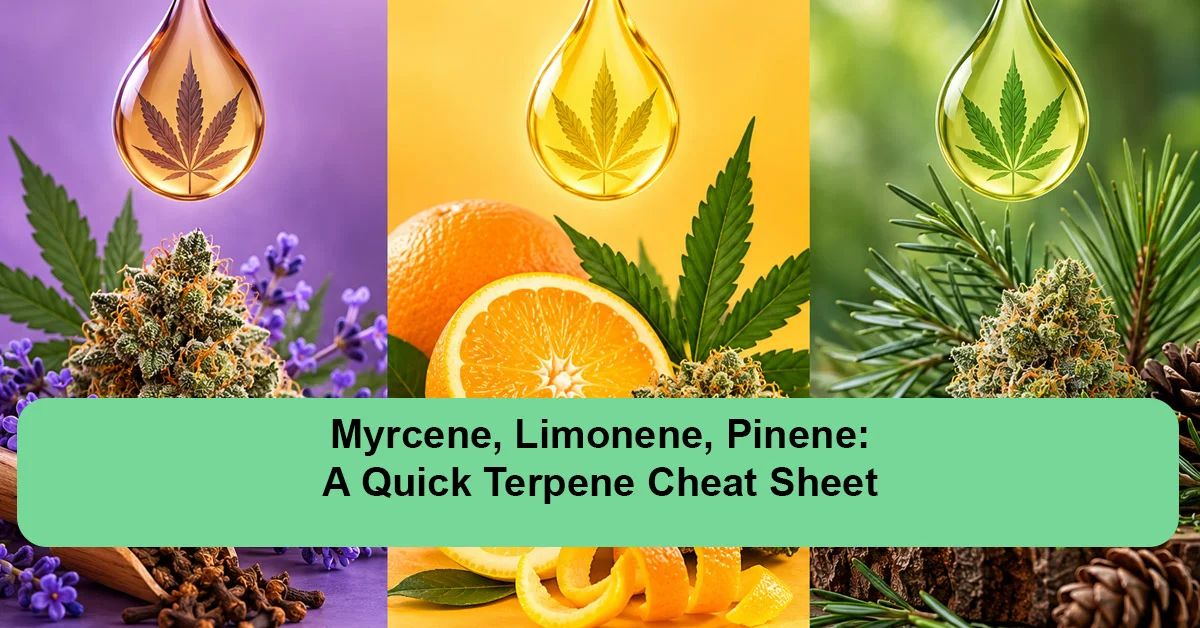
Open a jar at a dispensary and the first thing you notice is the smell. That aroma comes mostly from terpenes, the same family of compounds that gives lemons, pine needles, and hops their scent. As more dispensaries print terpene data on labels, shoppers are starting to choose cannabis by terpene profile instead of by strain name or indica and sativa categories.
This cheat sheet covers the three terpenes you will see most often on labels: myrcene, limonene, and pinene. For each one, you will learn how to recognize it, where else it shows up in nature, and, most importantly, what the research does and does not support. A lot of terpene marketing runs ahead of the science, and knowing the difference will make you a sharper shopper.
Terpenes are aromatic compounds produced by many plants. In cannabis, they are made in the same tiny resin glands, called trichomes, that produce THC and CBD. They make up a small fraction of the flower's weight, but they shape aroma and flavor dramatically.
Many consumers believe terpenes also shape the effects of cannabis, an idea often called the entourage effect. That belief is widespread, and some early research supports pieces of it, but the evidence is still limited and in places contradictory. Treat terpene effect claims as hypotheses worth exploring, not settled facts.
One finding is well supported: terpene profiles tell you more about a product than indica, sativa, or hybrid labels do. A large 2022 analysis published in PLOS ONE examined close to 90,000 cannabis samples from six states and found that those three labels did not reliably correspond to distinct chemical profiles. Instead, samples grouped more naturally by their dominant terpenes, with common clusters built around combinations such as caryophyllene and limonene, myrcene and pinene, and terpinolene and myrcene.
| Terpene | Aroma | Also Found In | Common Claim | What the Evidence Says |
|---|---|---|---|---|
| Myrcene | Earthy, musky, herbal, sometimes fruity | Hops, mango, lemongrass, thyme | Causes "couch-lock" sedation | Based mainly on high-dose animal studies; recent research challenges the link |
| Limonene | Citrus peel, bright, sweet | Orange and lemon rinds, juniper | Uplifting, may ease THC anxiety | A small human study found it reduced THC-related anxiety at doses above typical flower levels |
| Pinene | Pine, fresh, resinous | Pine trees, rosemary, basil | Alertness, offsets THC memory fog | Mostly theoretical and preclinical; not confirmed in cannabis users |
Myrcene smells earthy, musky, and slightly herbal, sometimes with a ripe fruit note. It is one of the most common dominant terpenes in commercial cannabis, which means many strains share at least some of this background aroma. Outside cannabis, it is abundant in hops, lemongrass, thyme, and mango.
Myrcene is often called the terpene behind heavy, sedating "couch-lock." This idea has roots in real research: older rodent studies found sedative and muscle-relaxing effects, but at doses far beyond what a person would get from smoking or vaping cannabis. An influential 2011 review proposed that myrcene could intensify THC's sedative effects, and that hypothesis spread through dispensary marketing as if it were proven.
More recent work complicates the story. A study titled "Absence of Entourage" tested several common cannabis terpenes, including myrcene, and found they did not activate cannabinoid receptors or change how THC acted at those receptors in the lab assay used. That does not rule out every possible pathway, but it undercuts the simplest version of the claim.
You may have heard that eating a mango before consuming cannabis intensifies the high because of myrcene. There is no peer-reviewed evidence supporting this. It makes for a fun experiment, but it is folklore, not pharmacology.
Shopper takeaway: A myrcene-dominant label tells you to expect an earthy, musky aroma. It does not guarantee a sleepy experience. Dose and THC content matter far more.
Limonene smells like citrus peel: bright, sweet, and sharp. Strains high in limonene often carry lemon, orange, or candy-like aromas. It is the main aromatic compound in citrus rinds and appears in many cleaning products and perfumes for the same reason.
Limonene has one of the more interesting recent human studies behind it. In 2024, researchers at Johns Hopkins published a double-blind study in which 20 healthy adults vaporized THC alone, d-limonene alone, both together, or a placebo across multiple sessions. When the higher THC dose was paired with the highest limonene dose, participants reported significantly less anxiety and paranoia than with THC alone, while other THC effects were largely unchanged.
There are important caveats. The study was small, participants were healthy occasional users, and the researchers noted that the anxiety-reducing effect appeared at limonene amounts higher than those typically found in cannabis flower. In other words, a limonene-rich strain is not proven to prevent anxiety. The research is a promising early step, not a reason to treat limonene as an anxiety remedy.
Shopper takeaway: If high-THC products sometimes make you uneasy, limonene-forward options are a reasonable thing to try, but lowering your THC dose remains the most reliable way to reduce that risk.
Pinene smells exactly like it sounds: pine forests, fresh resin, and herbs such as rosemary and basil. There are two main forms, alpha-pinene and beta-pinene, and labels may list them separately. Pinene is the most abundant terpene in the natural world, though it is less often the top terpene in cannabis than myrcene or limonene.
Pinene is frequently described as promoting alertness and counteracting THC's short-term memory effects. The theory comes from laboratory findings that pinene may slow the breakdown of acetylcholine, a brain chemical involved in memory. Some animal research has also explored mood-related effects. A frequently cited review describes pinene as a bronchodilator based on older research.
None of these claims has been confirmed in controlled studies of people consuming cannabis. They are plausible starting points for research, not established effects.
Shopper takeaway: Choose pinene-forward strains if you enjoy a crisp, foresty flavor. Do not count on pinene to keep you sharp after a high THC dose.
Once you start reading labels, these names show up often enough to be worth a quick note.
Most products contain dozens of terpenes. The top two or three by percentage shape the aroma most. A strain listed as myrcene, then limonene, then caryophyllene will smell different from one led by limonene and caryophyllene, even if both share a name.
Total terpene percentage can signal freshness and quality, but a higher number does not mean stronger effects. Use terpene data to match flavor preferences and track your own experiences rather than as a potency scale.
Where state rules and store policies allow, smelling a sample jar is one of the most practical tests available. If a product smells flat or hay-like despite a strong terpene label, it may be old or poorly stored.
Because individual responses vary, your own notes may be the most useful data you have. Record the product, dominant terpenes, THC percentage, amount used, and how you felt. Over time, patterns may emerge that no label can predict.
Terpenes are volatile, meaning they evaporate and degrade with heat, light, and air. Store flower in an airtight container in a cool, dark place, and check harvest or packaging dates when you buy.
When you find a terpene profile you enjoy, browsing strain pages on Dispensary.click can help you identify similar strains and the dispensaries near you that may carry them. Since profiles vary by grower and batch, confirm with the product's lab results.
This article was reviewed by the Dispensary Click Editorial Team for accuracy, clarity, and relevance. Information may be sourced from publicly available cannabis resources, state regulatory agencies, and lab-testing references where applicable.
Last reviewed: October 2026
Cannabis 101
 Cannabis 101
 Cannabis 101
 Cannabis 101