
 Cannabis 101
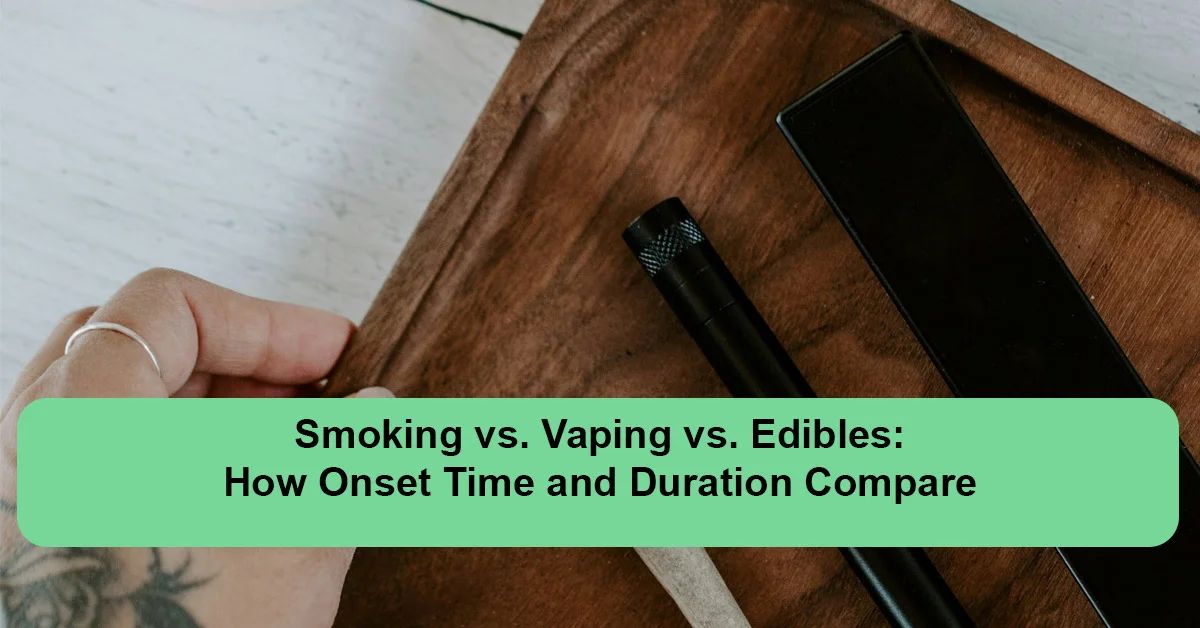
Smoking vs. Vaping vs. Edibles: How Onset Time and Duration...
Published On 03-10-2026
Published by Dispensary.Click Research & Editorial Team
Two people can use the same amount of THC and have completely different evenings. One feels effects within minutes and is back to normal by dinner. The other feels nothing for an hour, then finds the effects building well into the night. The difference is often not the strain or the dose, but how the cannabis entered the body.
Understanding onset time and duration is one of the most practical things a cannabis consumer can learn. It helps you avoid the most common overconsumption mistake, plan around your day, and choose a format that fits what you actually want. This guide compares smoking, vaping, edibles, beverages, and tinctures side by side.
Timing varies from person to person, so treat these as typical ranges drawn from public health guidance rather than exact predictions.
| Format | Typical Onset | Typical Peak | Typical Duration |
|---|---|---|---|
| Smoking flower | Seconds to a few minutes | About 15 to 30 minutes | About 2 to 4 hours |
| Vaping flower or oil | Seconds to a few minutes | About 15 to 30 minutes | About 2 to 4 hours |
| Tinctures held under the tongue | About 15 to 30 minutes, sometimes longer | About 90 minutes to 2 hours | Up to about 6 hours |
| Edibles and swallowed products | About 30 minutes to 2 hours, occasionally 3 | About 2 to 4 hours | About 6 to 8 hours or longer |
For both inhaled and ingested cannabis, residual effects such as drowsiness or slowed reactions can linger beyond the main experience, in some cases up to 24 hours.
When you smoke or vape, THC passes from the lungs directly into the bloodstream and reaches the brain within moments. That is why the effects of inhalation build quickly and why they fade comparatively fast.
The big advantage of inhalation is feedback. Because you feel effects within minutes, you can pause, assess, and decide whether you want more. This makes inhaled cannabis easier to adjust in real time, which is one reason many consumers prefer it when trying a new product.
The downside is that the amount of THC in each puff is hard to measure. Inhalation depth, how long you hold it, the device, and the product's potency all change how much you absorb.
Smoking and vaping work on a similar timeline, but they differ in other ways that matter.
Smoking burns cannabis, producing smoke that contains tar and other combustion byproducts. Public health agencies consider smoking the most harmful way to consume cannabis for the lungs, with risks of respiratory irritation and lung disease. Smoking also wastes some THC as smoke drifts away between puffs.
Vaping heats cannabis or cannabis oil without burning it. Public health guidance generally describes vaping as less harmful to the lungs than smoking, but not risk-free. There are two main types:
In 2019, a U.S. outbreak of serious lung injuries was linked largely to vitamin E acetate in vape cartridges, most of them obtained from informal or illicit sources. Buying from licensed dispensaries, where products are tested under state rules, reduces the risk of contaminated or unregulated cartridges.
When you swallow cannabis, THC travels through the digestive system to the liver before reaching your bloodstream. The liver converts some of it into 11-hydroxy-THC, a compound that readily reaches the brain and contributes to the strong effects many people report from edibles. Canadian public health organizations note that this conversion, combined with the original THC, can make the high from edibles feel more intense.
This is why the experience of eating cannabis often feels different, and sometimes stronger and more body-focused, than inhaling a similar amount.
The most common edible mistake is impatience. Because effects can take an hour or more to appear, people often assume the product is weak and take another dose. Then both doses take effect together, sometimes producing anxiety, nausea, a racing heart, or an uncomfortably long experience.
Public health guidance generally advises new edible users to start with 2.5 mg of THC or less and wait before taking more. Waiting at least two hours is a common rule of thumb, and some guidance cautions against consuming more within four hours.
Your stomach contents affect how edibles act. A full stomach can delay onset and alter how strongly effects appear. Metabolism, body composition, and individual differences also play a role, which is why the same edible can feel different on different days.
Tinctures can be used two ways. Held under the tongue for a minute or so, some cannabinoids may absorb through the mouth, often producing faster effects than swallowing. If swallowed right away, a tincture behaves more like an edible.
Some beverages and edibles are marketed as fast-acting or quick-onset, often using emulsification technology intended to speed absorption. Some consumers report quicker effects, but timing varies between products and people. Treat these items with the same patience you would any edible until you know how they affect you.
Dabbing means vaporizing a small amount of concentrate, such as wax, shatter, or rosin, on a heated surface. It follows the same fast inhaled timeline as smoking and vaping, but because concentrates are so potent, a single dab can deliver a very large dose of THC at once. Dabbing is generally better suited to experienced consumers with established tolerance, and beginners should avoid it.
Cannabis lotions, balms, and salves are applied to the skin. Standard topicals are generally not considered intoxicating because little THC is thought to reach the bloodstream, and people typically use them for localized purposes. Transdermal patches are different: they are designed to deliver cannabinoids into the bloodstream and can produce effects, so read the label carefully to know which type you are buying. Evidence for many topical benefits remains limited.
| If You Want... | Formats to Consider | Why |
|---|---|---|
| Quick effects you can adjust | Dry herb vaporizer or flower | Fast onset gives immediate feedback |
| A shorter experience | Inhaled products | Effects usually fade within a few hours |
| Precise, measured doses | Low-dose edibles, measured tinctures | Labels list milligrams per serving |
| Longer-lasting effects | Edibles or capsules | Effects can last six hours or more |
| To avoid inhaling anything | Edibles, beverages, tinctures | No smoke or vapor involved |
If you are new to cannabis, inhaled flower at moderate potency or a low-dose edible are common starting points, each with its own trade-offs. People with respiratory conditions should talk with a healthcare professional before inhaling anything.
Format availability and product rules differ by state, and some states limit certain products to medical patients. Dispensary.click's dispensary listings can help you find licensed shops near you and compare which formats they carry. Cannabis is legal only in certain states and only for adults who meet each state's requirements.
This article was reviewed by the Dispensary Click Editorial Team for accuracy, clarity, and relevance. Information may be sourced from publicly available cannabis resources, state regulatory agencies, and lab-testing references where applicable.
Last reviewed: October 2026
Cannabis 101
 Cannabis 101
 Cannabis 101
 Cannabis 101