
 Cannabis 101
Smoking vs. Vaping vs. Edibles: How Onset Time and Duration...
Published On 03-10-2026
Published by Dispensary.Click Research & Editorial Team
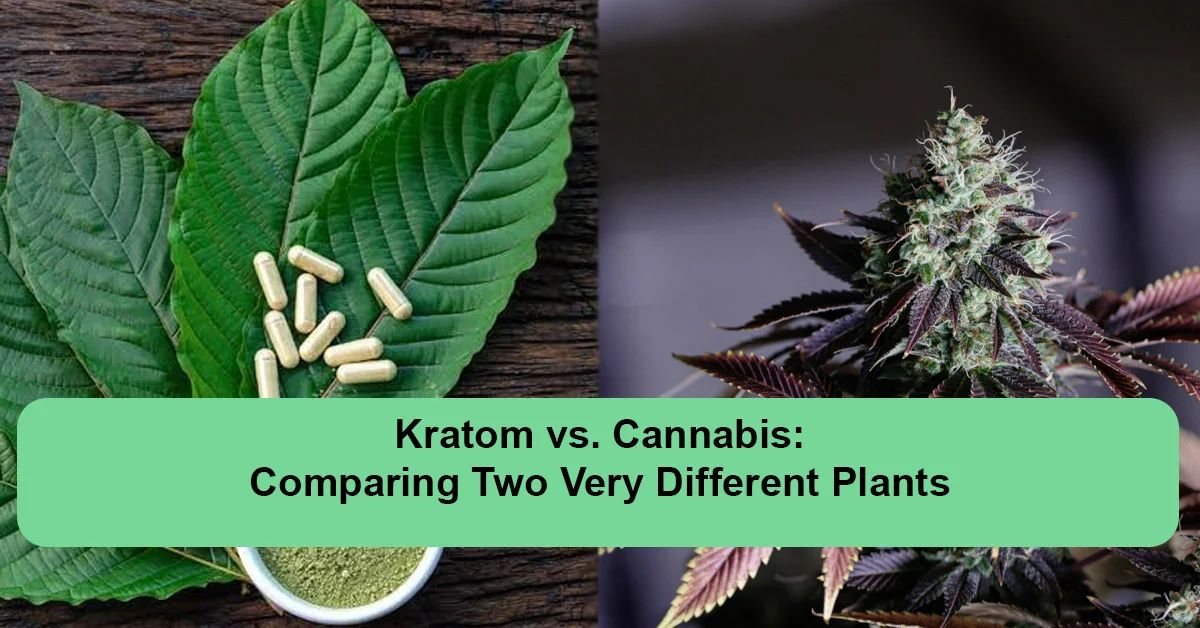
Kratom and cannabis frequently end up sold in the same physical spaces, smoke shops, some dispensaries, and specialty wellness retailers, which understandably leads people to lump them together as similar substances. They aren't. Kratom comes from an entirely different plant family, works through a different mechanism in the body, and exists in a genuinely different, often murkier legal category than cannabis. Understanding those differences matters if you're considering either one, since treating them as interchangeable products can lead to real misunderstandings about effects, risks, and legality.
Kratom comes from the leaves of Mitragyna speciosa, a tropical tree native to Southeast Asia and part of the coffee plant family, botanically unrelated to cannabis. Its two primary active compounds, mitragynine and 7-hydroxymitragynine, interact with opioid receptors in the brain, which is a fundamentally different mechanism than how THC or CBD interact with the body's cannabinoid receptor system.
Kratom is typically sold as a dried, crushed leaf powder, in capsules, or as a concentrated extract, and is most commonly associated with claims around pain relief, energy, and mood, though its opioid-receptor activity means it carries a different risk profile than cannabis, including documented potential for dependence with regular use. If you're specifically curious about the powder form, our guide to making kratom tea covers one of the most common preparation methods.
| Factor | Cannabis | Kratom |
|---|---|---|
| Plant family | Cannabaceae | Rubiaceae (coffee family) |
| Primary active compounds | THC, CBD, and other cannabinoids | Mitragynine, 7-hydroxymitragynine |
| Mechanism in the body | Interacts with the endocannabinoid system | Interacts with opioid receptors |
| Common forms | Flower, concentrates, edibles, tinctures, topicals | Powder, capsules, extracts, teas |
| Typical reported effects | Ranges from relaxation to euphoria to focus, depending on strain and dose | Stimulating at lower doses, sedating and pain-relieving at higher doses |
This opioid-receptor mechanism is the single most important thing to understand about kratom if you're familiar with cannabis but new to kratom. It behaves more like a mild opioid in terms of its interaction with the body than anything cannabis does, which affects both its potential benefits and its risk profile in ways that don't map onto cannabis at all.
Cannabis legality is a well-mapped, if complicated, patchwork of state-by-state recreational and medical programs, alongside a federal system that treats state-licensed medical marijuana differently than recreational marijuana following this year's partial rescheduling action.
Kratom's legal situation is different and, in some ways, murkier. It's not scheduled under the federal Controlled Substances Act, meaning it remains legal at the federal level, but several states and municipalities have independently banned or restricted it, sometimes citing safety concerns raised by federal health agencies that have periodically expressed concern about kratom's risks, including potential for dependence and reports of contamination in unregulated products. This creates a legal landscape that's arguably less consistent and harder to track than cannabis law, precisely because there's no equivalent to the broad, structured state licensing systems cannabis has developed.
This is one of the most important practical differences for anyone shopping for either product. Licensed cannabis dispensaries operate under state-mandated testing requirements for potency, pesticides, heavy metals, and microbial contamination. Kratom, sold largely through smoke shops and online retailers without an equivalent licensing and testing framework in most places, has a much less consistent quality control landscape. Reports of contaminated or adulterated kratom products, sometimes spiked with other substances, have been a recurring concern precisely because of this regulatory gap.
If you're considering kratom, buying from a retailer that provides third-party lab testing results, confirming both potency and the absence of contaminants, is a meaningfully more important precaution than it typically is with licensed dispensary cannabis, simply because the regulatory safety net most cannabis consumers take for granted often doesn't exist in the same way for kratom.
Kratom and certain hemp-derived cannabis products, like Delta-8 or high-THCA flower, frequently end up sold through the same retail channels, smoke shops and specialty wellness stores, largely because both occupy similar regulatory gray areas outside the tightly licensed, state-regulated cannabis dispensary system. This overlap in where they're sold is a matter of retail and regulatory convenience rather than any meaningful similarity between the substances themselves.
Kratom's regulatory situation has grown more complicated recently, particularly around concentrated extracts. Federal regulators have taken action specifically targeting concentrated and synthetically enhanced forms of 7-hydroxymitragynine, a compound related to kratom that occurs only in small amounts in the raw leaf but that some commercial products concentrate well beyond natural levels, producing a considerably more potent, opioid-like effect. This regulatory attention has been specifically aimed at those concentrated products rather than natural kratom leaf itself, but it's a useful reminder that kratom's legal and regulatory landscape remains genuinely unsettled and worth checking against current sources rather than assuming its status is fixed.
This is a reasonable moment to emphasize that kratom and cannabis, despite occasionally sharing shelf space, are subject to entirely separate regulatory processes moving on their own timelines, so developments affecting one substance shouldn't be assumed to say anything about the other's current or future legal status.
Because kratom interacts with opioid receptors, it carries a documented potential for dependence with regular, sustained use, a risk profile that's different in kind from cannabis dependence patterns. Kratom withdrawal symptoms have been reported and can resemble mild opioid withdrawal in some cases. This doesn't mean kratom is inherently unsafe for every user, but it does mean the risk conversation around kratom is genuinely different from the one around cannabis, and treating them as equivalent in terms of dependence risk would be inaccurate.
This article was reviewed by the Dispensary Click Editorial Team for accuracy, clarity, and relevance. Information may be sourced from publicly available cannabis resources, state regulatory agencies, and lab-testing references where applicable.
Last reviewed: September 2026
Cannabis 101
 Cannabis 101
 Cannabis 101
 Cannabis 101