
 Cannabis 101
Kratom vs. Cannabis: Comparing Two Very Different Plants
Published On 09-09-2026
Published by Dispensary.Click Research & Editorial Team
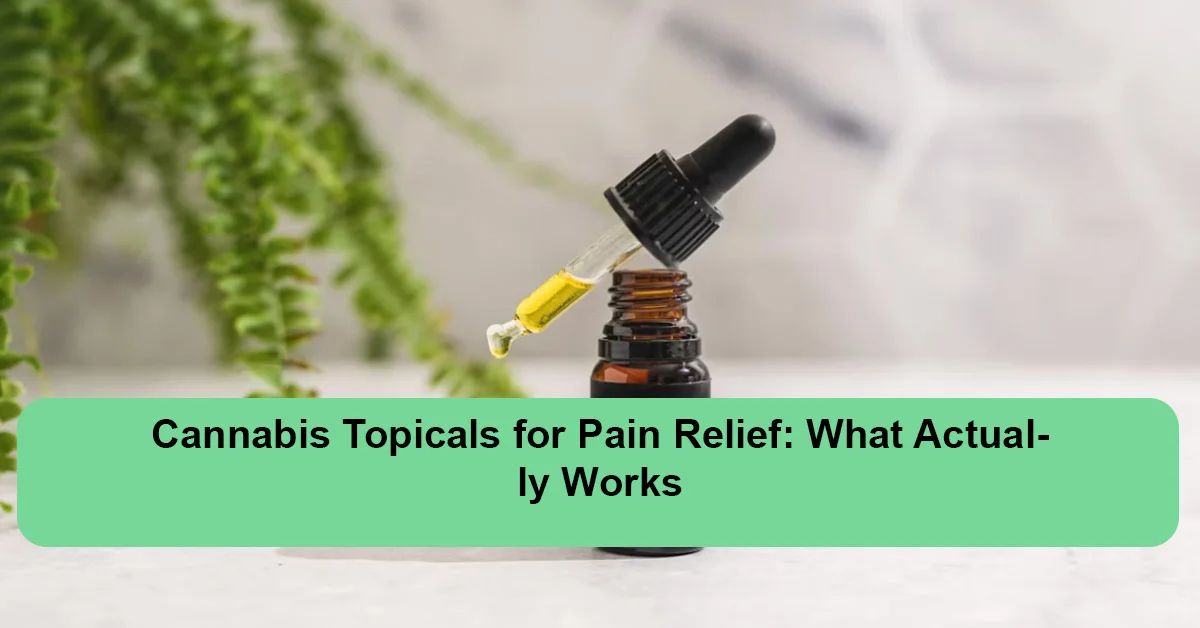
Cannabis topicals occupy an unusual place in the product lineup. They're sold in the same dispensaries as products meant to get you high, but most topicals are formulated specifically so they won't, applied to skin for localized relief rather than absorbed into the bloodstream the way smoking, edibles, or tinctures are. That distinction confuses a lot of first-time buyers, and it's the key to understanding whether a topical is actually the right choice for the kind of pain you're dealing with.
This guide covers how cannabis topicals actually work at a physiological level, what current research does and doesn't support, and how to pick a product that matches the type of pain you're trying to address, since not every topical is built the same way or aimed at the same problem.
This article is for general information and isn't medical advice. If you're managing chronic or serious pain, talking with a doctor about your options, including whether cannabis topicals make sense alongside your current treatment, is the safest starting point.
Most cannabis topicals are designed to interact with cannabinoid receptors located in the skin and surrounding tissue rather than entering the bloodstream in meaningful amounts. This is why a standard cannabis topical, even one with a high THC content, generally won't produce an intoxicating high the way smoking or eating cannabis would. THC molecules are too large to efficiently cross the skin barrier and reach the bloodstream in significant quantities through standard topical application.
The body has cannabinoid receptors, part of what's known as the endocannabinoid system, distributed throughout skin, muscle, and connective tissue, not just the brain. When a topical is applied, cannabinoids interact with these localized receptors, which is the proposed mechanism behind the relief some users report for muscle soreness, joint discomfort, and localized inflammation.
It's worth being direct about where the science currently stands. Research specifically on cannabis topicals in humans is still limited compared to research on oral or inhaled cannabis, partly due to regulatory barriers that have historically restricted large-scale clinical studies. Some existing research, including animal studies and smaller human trials, suggests cannabinoids applied to skin may help reduce inflammation and certain types of localized pain, but larger, more rigorous human trials are still needed to establish clear, reliable conclusions about effectiveness, ideal dosing, and which formulations work best for which conditions.
What this means practically is that a lot of what's known about cannabis topicals right now comes from user-reported experience and early-stage research rather than the kind of extensive clinical data available for many over-the-counter pain products. That doesn't mean topicals don't work, many users report genuine relief, but it does mean the claims on packaging should generally be read with some healthy skepticism rather than treated as clinically proven fact.
| Type | Typical Use | Absorption Depth |
|---|---|---|
| Lotions and creams | General muscle soreness, everyday application | Surface-level |
| Balms and salves | Targeted joint or muscle discomfort, thicker application | Surface to shallow tissue |
| Transdermal patches | Sustained, longer-lasting application over hours | Can enter bloodstream in small amounts |
| Roll-ons and sticks | Quick, mess-free application to a specific spot | Surface-level |
| Bath soaks | Broader, full-body relaxation and muscle relief | Surface-level |
Transdermal patches are the notable exception on absorption. Unlike other topical formats, patches are specifically engineered to push cannabinoids through the skin barrier and into the bloodstream over an extended period, which means they can produce mild systemic effects, and in some higher-THC formulations, even a slight intoxicating effect. If you specifically want a topical that stays local and won't affect you systemically, a standard lotion, balm, or roll-on is a more predictable choice than a patch.
Both THC and CBD topicals are widely available, often blended together in the same product, and the difference matters less for topicals than it does for products you'd smoke or eat, since neither typically produces significant intoxication when applied to skin in standard formulations. Some users report that THC-inclusive topicals feel more effective for their specific pain than CBD-only versions, though this varies a lot person to person and isn't something current research has clearly settled. Given the minimal risk of intoxication either way, trying both formulations and noting which one you personally respond to is a reasonable approach.
Application technique genuinely affects outcomes with topicals more than with most other cannabis products. Using a generous, even amount rather than a token dab, massaging it into the skin thoroughly rather than leaving it sitting on the surface, and applying to clean, dry skin rather than over lotion or sunscreen residue all support better absorption. Reapplying within the timeframe suggested on the label, since topical effects tend to be shorter-lived than oral products, is also worth building into a routine if you're using a topical regularly rather than as a one-off.
Topicals are generally best suited to localized, surface-level discomfort, sore muscles after exercise, minor joint stiffness, or targeted areas of tension. For deep, widespread, or systemic pain, a topical alone may not provide meaningful relief, since it isn't designed to reach deep tissue or circulate through the body the way an oral or inhaled product does. In those cases, other formats, or a broader conversation with a healthcare provider about pain management options, are likely to be more effective than relying on a topical by itself.
This article was reviewed by the Dispensary Click Editorial Team for accuracy, clarity, and relevance. Information may be sourced from publicly available cannabis resources, state regulatory agencies, and lab-testing references where applicable.
Last reviewed: August 2026
Cannabis 101
 Cannabis 101
 Cannabis 101
 Cannabis 101