
 Strains & products
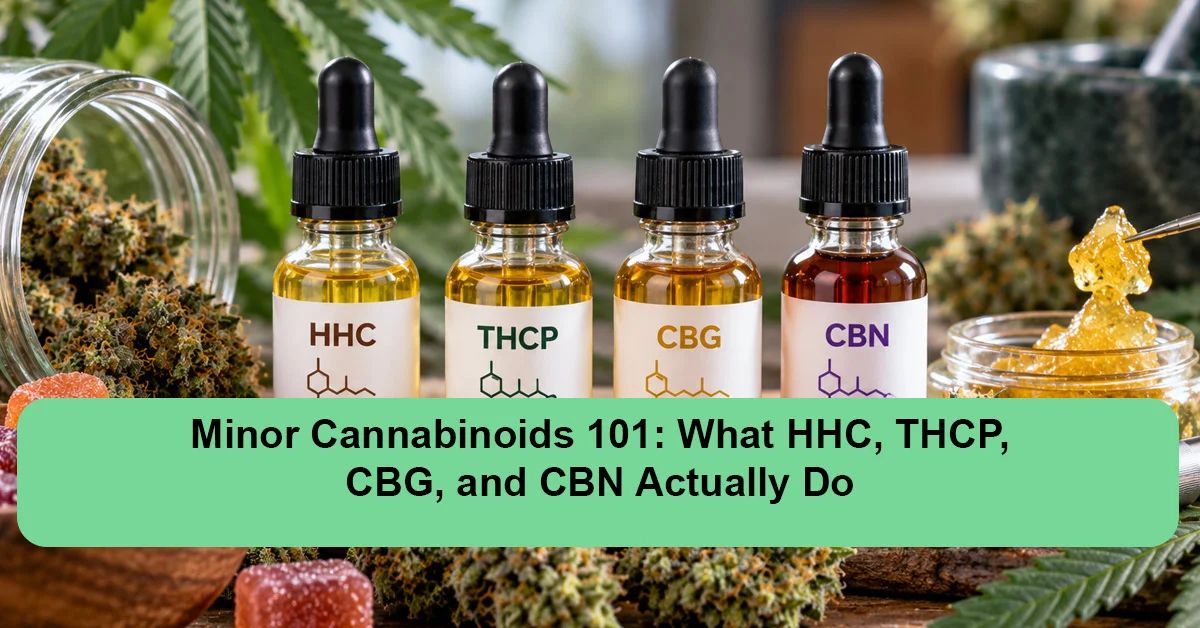
Minor Cannabinoids 101: What HHC, THCP, CBG, and CBN Actuall...
Published On 06-09-2026
Published by Dispensary.Click Research & Editorial Team

If you've ever noticed that a full-spectrum product feels noticeably different from a THC or CBD isolate, even at a similar dose, you've experienced the basic idea behind the entourage effect firsthand. It's one of the most frequently cited concepts in cannabis science, showing up on product labels, in dispensary conversations, and across countless articles, but it's also a term that gets used more loosely than the underlying research actually supports. Understanding what it really means, and where the evidence is solid versus still developing, makes it a genuinely useful concept rather than just a marketing buzzword.
The entourage effect refers to the theory that cannabis compounds, cannabinoids like THC and CBD, terpenes, and flavonoids, work better together than any single compound would on its own. Rather than THC acting as a lone psychoactive switch, the theory holds that the surrounding compounds in the plant modulate, soften, or enhance THC's effects, producing a more balanced or nuanced overall experience than an isolated dose of pure THC alone.
This concept was first proposed by cannabis researchers studying how the plant's dozens of compounds might interact with each other and with the body's endocannabinoid system. It offered an explanation for something a lot of experienced cannabis users had already noticed anecdotally: that whole-plant products often felt different, and for many people more balanced, than synthetic or isolated THC products.
A few specific interactions come up most often in entourage effect discussions.
It's worth being direct here: the entourage effect is a genuinely reasonable and widely discussed theory, but it remains an area of active scientific research rather than a fully settled, conclusively proven mechanism. Some studies, including research on specific cannabinoid and terpene combinations, support the general idea that whole-plant or multi-compound products can behave differently than isolated compounds. At the same time, rigorous, large-scale human research specifically isolating and testing the entourage effect is still limited, partly due to the same regulatory barriers that have historically slowed broader cannabis research.
This means the entourage effect sits in a reasonable middle ground: it's not baseless marketing, there's real scientific reasoning and some supporting research behind it, but it's also not as definitively proven as some product marketing implies. Approaching claims about specific entourage effect benefits with informed curiosity rather than either total dismissal or complete certainty is the most accurate way to think about it right now.
| Product Type | What It Contains | Entourage Effect Relevance |
|---|---|---|
| Full-spectrum | A wide range of cannabinoids, terpenes, and flavonoids from the original plant | Highest potential for entourage-related interaction, since more compounds are present |
| Broad-spectrum | Multiple cannabinoids and terpenes, but with specific compounds (often THC) removed | Some entourage-related interaction possible, minus the removed compound's contribution |
| Isolate | A single, purified cannabinoid (commonly CBD or THC) with no other plant compounds | Minimal to no entourage effect, since supporting compounds are absent |
If you're specifically curious about the entourage effect and want to experience the concept firsthand, comparing how a full-spectrum product feels against an isolate product with a similar cannabinoid dose is a reasonably direct way to form your own impression, even without waiting for more definitive research.
Understanding the entourage effect concept helps explain a few practical shopping decisions:
Because "entourage effect" sounds scientific and carries some genuine research behind it, it's become a convenient phrase for marketing almost any multi-ingredient cannabis product, sometimes well past what the underlying evidence actually supports. It's worth watching for a few common overreaches:
None of this means the concept isn't worth taking seriously, it clearly is. It just means a product's entourage effect claims are only as meaningful as the actual lab data backing them up, and checking the certificate of analysis for real cannabinoid and terpene percentages is a more reliable way to evaluate a product than the marketing language on its packaging.
The entourage effect is best understood as a reasonable, actively researched theory with real anecdotal and some scientific support, not an unproven myth and not an ironclad scientific fact either. It offers a useful framework for understanding why whole-plant cannabis products often feel more nuanced or balanced than isolated compounds, while leaving room for the reality that science hasn't fully mapped out exactly how, or how much, each compound contributes to that experience. For most consumers, the practical takeaway is simple: if you're curious whether a fuller-spectrum product feels different to you personally than an isolate, trying both and paying attention to your own experience is a reasonable way to explore the concept directly.
This article was reviewed by the Dispensary Click Editorial Team for accuracy, clarity, and relevance. Information may be sourced from publicly available cannabis resources, state regulatory agencies, and lab-testing references where applicable.
Last reviewed: September 2026
Strains & products
 Strains & products
 Strains & products
Strains & products
Strains & products