
 Strains & products
Sativa Effects: What They Actually Feel Like
Published On 03-10-2026
Published by Dispensary.Click Research & Editorial Team
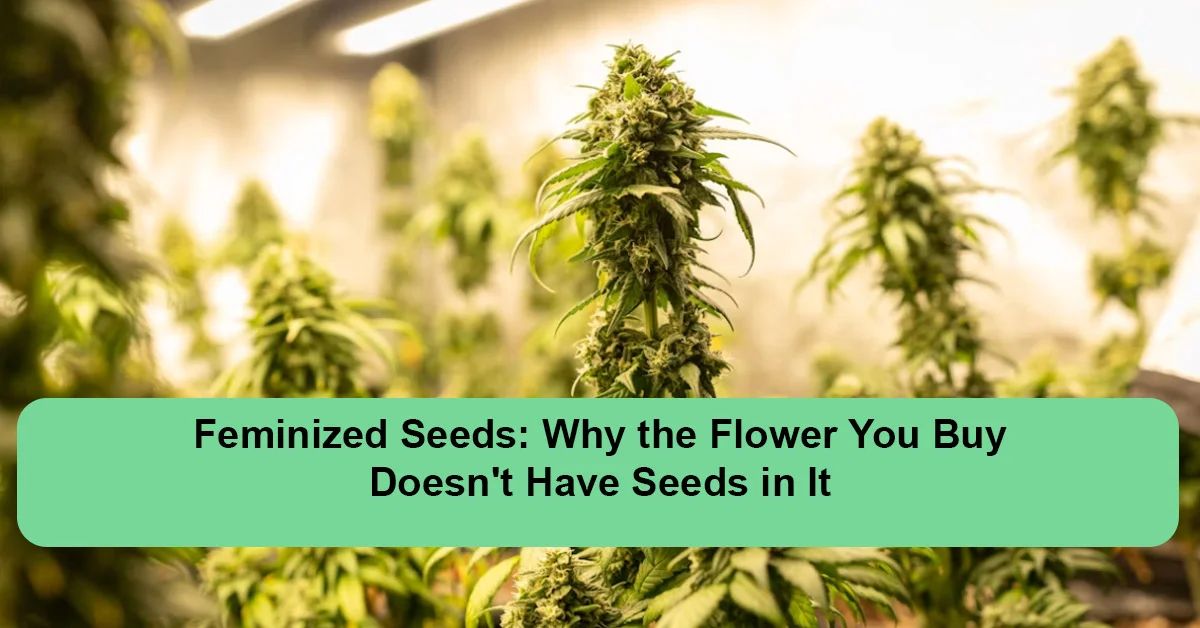
If you've ever cracked open an older bag of cannabis, maybe something bought years ago or from a less careful source, and found small hard seeds scattered through the buds, you've encountered something that's become genuinely rare in today's regulated dispensary market. Modern legal flower is almost always seedless, dense, and resin-covered in a way that older or unregulated cannabis often wasn't. That shift didn't happen by accident. It's the direct result of feminized seed technology becoming the industry standard for commercial cultivation.
You don't need to be a grower to benefit from understanding this, in fact, most people who buy cannabis at a dispensary have no plans to grow anything at all. But knowing what feminized seeds are and why they matter explains a lot about the quality, consistency, and appearance of the flower sitting in your jar, and it's worth understanding as a buyer, not just as a cultivator.
Cannabis plants are naturally either male or female, and only female plants produce the resinous, cannabinoid-rich flowers that people actually want to consume. Male plants produce pollen sacs instead of usable buds, and if a male plant pollinates a female plant nearby, the female's energy shifts toward seed production rather than continuing to develop dense, resinous flower. The result is buds packed with seeds, lower in cannabinoid content, and generally considered lower quality by most standards.
Traditionally, growers working with regular (non-feminized) seeds had no way to know in advance which seeds would sprout male and which would sprout female, roughly a 50/50 split. That meant growing out a batch of plants, waiting weeks to identify and remove the males, and effectively wasting half the crop's growing space and resources on plants that would never produce usable flower, all while risking accidental pollination if a male wasn't caught in time.
Feminized seeds are bred specifically to produce almost exclusively female plants, removing the guesswork and the wasted growing space that regular seeds require. This is typically achieved by inducing a female plant to produce pollen (through stress-induced or chemical methods) and using that female-derived pollen to fertilize another female plant. Since both parent plants carry only female genetic material, the resulting seeds overwhelmingly produce female offspring, generally cited in the 99% range for properly produced feminized seed batches.
This isn't a form of genetic modification in the way the term is often used for other crops. It's a pollination technique that works within the plant's natural biology, just directed specifically to avoid the male plants that commercial growers have no use for in the first place.
As a buyer, the shift to feminized genetics affects the product sitting on dispensary shelves in a few direct ways:
It's worth noting that feminized seeds aren't the only way growers ensure an all-female crop. Clones, cuttings taken directly from an established female "mother" plant, are genetically identical to their source and guarantee female offspring without any seed germination at all. Many commercial cultivators use a combination of both approaches, feminized seeds for introducing new genetics or strains, and clones for reliably reproducing an already-proven female plant at scale. As a buyer, this distinction doesn't change what ends up in your jar, seedless flower either way, but it explains why you'll sometimes hear growers and industry publications discuss "clone-only" strains as a mark of certain genetic lines being preserved with extra care.
From a buyer's standpoint, genuinely very little. The main considerations are more relevant to growers than to dispensary customers:
Feminization techniques for cannabis weren't developed overnight, they emerged from breeders experimenting with stress-induced and chemical methods to force female plants to produce viable pollen, borrowing techniques already established in other agricultural crops facing similar male/female production challenges. Early feminization methods in cannabis cultivation, dating back several decades within breeding circles, were refined considerably as legal markets opened up and the financial incentive to maximize usable plant yield per grow cycle increased substantially.
Once cannabis cultivation moved from primarily underground, small-scale operations into large, regulated commercial facilities, the economics made feminized seeds close to essential. A commercial grower operating a facility with strict square footage and lighting costs simply can't justify devoting half their growing capacity to male plants that will never generate revenue. This economic pressure, combined with steadily improving feminization techniques, is what pushed feminized genetics from a niche breeding tool into the near-universal standard it represents in commercial cultivation today.
Feminized seed technology is one of those behind-the-scenes industry shifts that most consumers never think about, but that shapes the product experience in a very direct way. The dense, seedless, consistently potent flower that's become the baseline expectation at any decent dispensary exists largely because of this breeding approach becoming standard across commercial cultivation. Understanding it doesn't require growing a single plant yourself, it just explains why modern cannabis looks and performs the way it does compared to what was typical in decades past.
The next time you open a jar of dispensary flower and notice how dense, resinous, and seed-free it is, that's not an accident of a particularly good harvest, it's the standard outcome of an industry-wide shift in cultivation practice. Feminized genetics, paired with careful growing conditions that prevent any pollination at all, are quietly responsible for turning what used to be an inconsistent, seed-flecked product into the reliably clean, potent flower most cannabis consumers now take for granted.
None of this is likely to change your day-to-day shopping decisions directly, most buyers will never need to know the difference between a feminized seed and a clone, or the specific pollination technique a breeder used. But it's a good example of how a lot of the quality improvements in legal cannabis over the past decade came from unglamorous, behind-the-scenes cultivation science rather than flashy new product categories, and it's worth appreciating the next time a jar of flower looks noticeably better than what you might remember from years ago.
This article was reviewed by the Dispensary Click Editorial Team for accuracy, clarity, and relevance. Information may be sourced from publicly available cannabis resources, state regulatory agencies, and lab-testing references where applicable.
Last reviewed: September 2026
Strains & products
 Strains & products
 Strains & products
 Strains & products