
 Buying Guides
7-OH and Semi-Synthetic Cannabinoids: What Buyers Should Act...
Published On 09-09-2026
Published by Dispensary.Click Research & Editorial Team
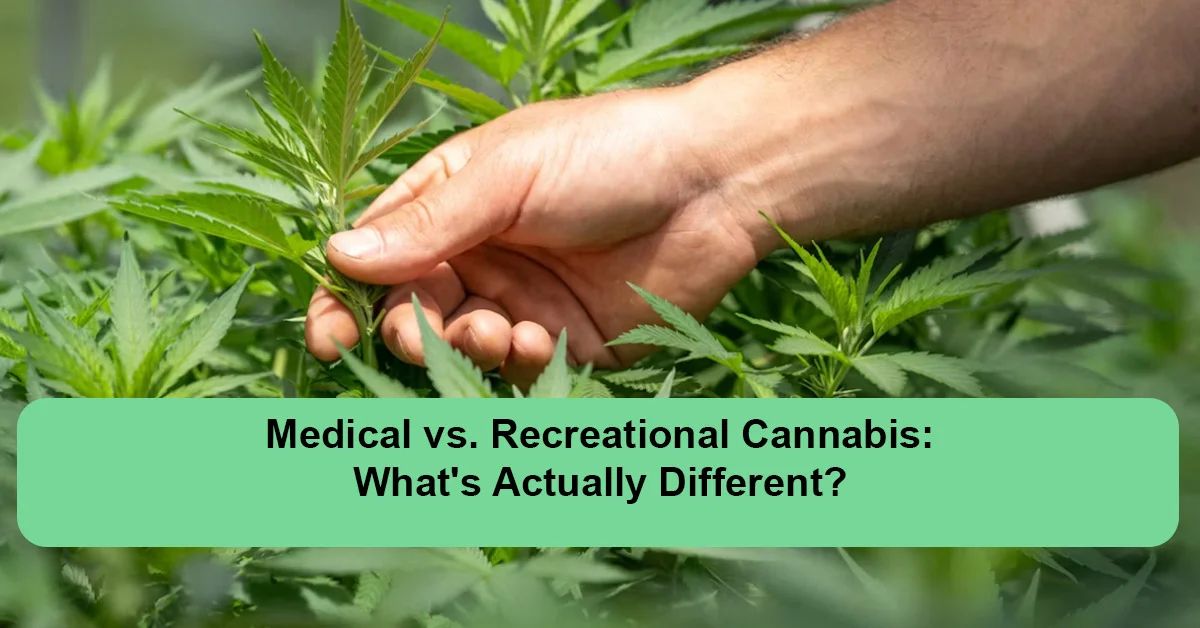
In states where both programs exist side by side, it's a fair question to ask whether medical and recreational cannabis are actually different products, or whether the distinction is mostly paperwork. The honest answer is somewhere in between. The cannabis itself is often identical, frequently the exact same jar of flower or vape cartridge sitting on the same shelf, but the surrounding system, cost, access, purchase limits, and product availability, can differ in ways that genuinely matter depending on your situation.
Medical cannabis programs require a qualifying medical condition, verified by a licensed physician, and typically a state-issued medical marijuana card or registration. Recreational, often called adult-use, programs simply require being of legal age, typically 21, with no medical qualification or physician involvement needed at all. This is the fundamental distinction everything else builds on: medical programs exist within a healthcare-adjacent regulatory framework, while recreational programs are structured more like alcohol retail. If you're visiting a dispensary for the first time under either program, our guide to what to expect covers the basics of the visit itself.
| Factor | Medical Cannabis | Recreational Cannabis |
|---|---|---|
| Minimum age | Varies by state, sometimes under 21 with guardian involvement for minors | 21 in nearly all states |
| Qualification required | Physician-certified qualifying condition | None, valid ID only |
| Taxes | Often lower or exempt from certain state cannabis taxes | Typically subject to full state and local cannabis excise taxes |
| Purchase limits | Often higher daily and monthly limits | Typically lower, standardized limits |
| Product potency options | Sometimes higher-potency products available exclusively | Often capped at lower maximum potency in certain product categories |
| Home cultivation allowance | Sometimes higher plant counts permitted | Often lower plant count limits, or none in some states |
In many states with both program types, medical cannabis carries reduced state excise tax, sometimes a significant discount compared to recreational pricing on the exact same product. For someone who uses cannabis regularly, this tax difference alone can make the process of obtaining and renewing a medical card worthwhile purely on cost grounds, independent of any other consideration.
States commonly set lower daily or monthly purchase limits for recreational customers than for medical patients, reflecting the assumption that a medical patient may have a more consistent, higher-volume need for cannabis to manage an ongoing condition. If you find yourself regularly hitting recreational purchase caps, this is one of the more concrete, practical reasons people who qualify choose to pursue a medical card even in a state with full recreational access.
A number of states restrict certain higher-potency products, particularly some concentrates and higher-dose edibles, to medical patients only, reasoning that patients managing specific medical needs may require stronger products than the state considers appropriate for the general recreational market. Some medical programs also feature dedicated strain recommendations, like our medical strain guide for anxiety and stress relief, that go beyond what a typical recreational menu highlights. Whether this applies, and to which specific product categories, varies considerably by state, so checking your own state's specific rules is necessary rather than assuming a uniform national standard.
Recreational programs offer genuine benefits beyond simple convenience. No physician visit or ongoing card renewal is required, there's no need to disclose a specific medical condition to anyone, and the process of buying is as simple as showing valid ID. For someone who uses cannabis occasionally and doesn't have a clear qualifying medical condition, the added cost and administrative effort of a medical card often isn't worth it compared to the straightforward simplicity of recreational purchase.
Not every legal cannabis state has both systems. A number of states maintain medical-only programs without any recreational legalization, meaning a valid medical card and qualifying condition are required for any legal cannabis access at all in that state. Other states have moved to recreational legalization but maintain limited or no separate medical program, treating all adult consumers under the same recreational framework. Checking your specific state's program structure is essential before assuming both options are available.
One factor that doesn't always get discussed openly is the difference in privacy between the two paths. Obtaining a medical marijuana card typically involves your name and qualifying condition being registered in a state health database, information generally protected under health privacy law but still a form of record-keeping that recreational purchases don't require. For some people this is a non-issue, for others, particularly those in fields with strict background check requirements or personal concerns about medical record privacy, this is a genuine factor worth weighing against the cost and purchase-limit advantages a medical card offers.
It's worth asking your state program directly how patient information is stored and protected if this is a significant concern for you, since exact privacy protections and data retention policies vary by state rather than following a single national standard.
It's also worth revisiting this decision periodically rather than treating it as permanent. States occasionally adjust tax rates, purchase limits, and qualifying condition lists, and your own usage patterns may change over time, so what made sense when you first decided between medical and recreational access might not remain the better option indefinitely.
This article was reviewed by the Dispensary Click Editorial Team for accuracy, clarity, and relevance. Information may be sourced from publicly available cannabis resources, state regulatory agencies, and lab-testing references where applicable.
Last reviewed: September 2026
Buying Guides
Buying Guides
 Buying Guides